

The Topic Correlations view helps you discover which themes in your data tend to appear together, and the Correlation Explanation shows why they’re connected.Documentation Index
Fetch the complete documentation index at: https://docs.caplena.com/llms.txt
Use this file to discover all available pages before exploring further.
What It Shows
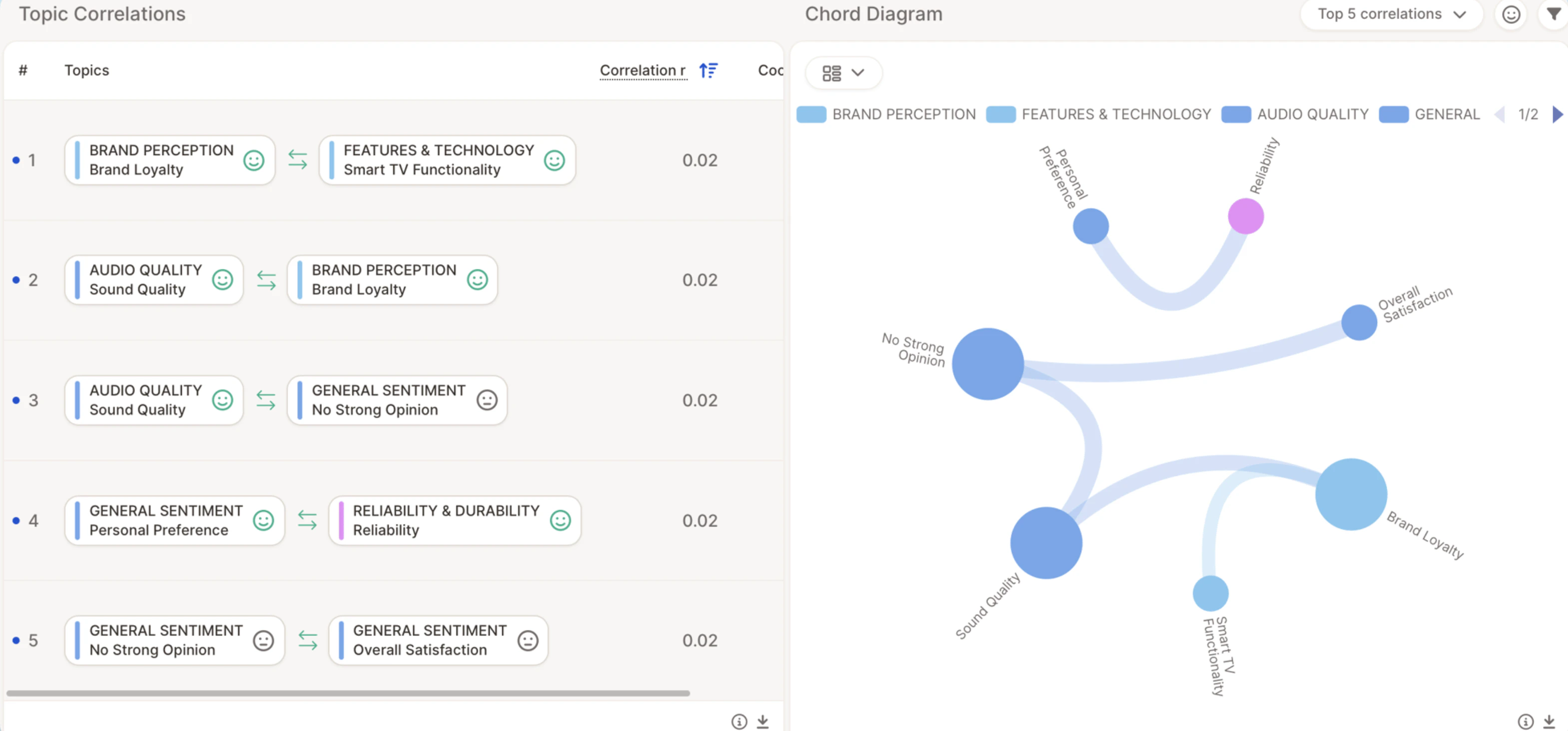
Caplena automatically detects relationships between topics that are frequently mentioned in the same responses. Each row in the table represents a pair of correlated topics, showing how strongly they are linked. The correlation score (r) tells you the strength of the relationship — higher values mean the topics co-occur more often.Example: Audio Quality ↔ Visual Quality (r = 0.53) — respondents who mention sound quality also often talk about picture quality.
Switch Between Views
On the right-hand side, you can explore your correlations in two different views:Chord Diagram
A visual map showing how your topics connect.- Each bubble represents a topic.
- Lines show connections between topics — the thicker the line, the stronger the correlation.
- Bubble size reflects how frequently a topic appears in your dataset.
Correlation Explanation
When you switch to this view, Caplena’s AI provides a written summary explaining the connection between the selected topics.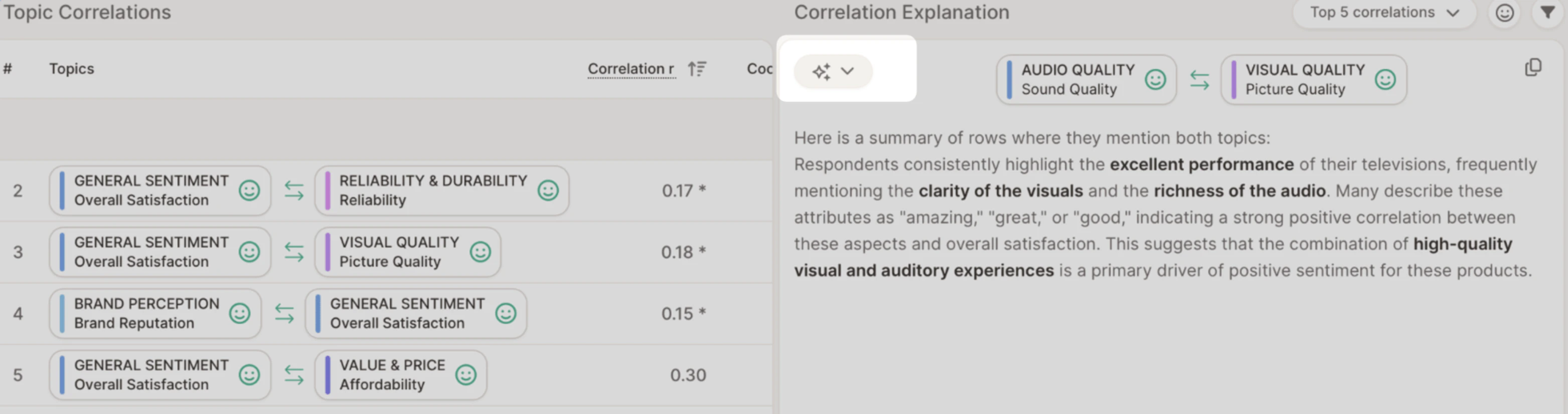
How the Correlation Metric Is Calculated
The correlation score is based on the Kulczyński measure (pronounced Kool-chin-ski). This score ranges from 0 to 1 and shows how likely two topics are to appear together.- A value close to 1 means the topics are strongly related.
- A value close to 0 means they rarely appear together.
The Idea Behind It
The Kulczyński score asks: “If I see Topic A, how often do I also see Topic B?” — and vice versa — then takes the average of both directions.That’s why it’s great for spotting balanced, meaningful relationships rather than random overlaps. Formula:
- A = number of responses mentioning both topics
- B = number of responses mentioning only Topic 1
- C = number of responses mentioning only Topic 2
- Design and Product mentioned together: A = 100
- Design mentioned alone (without Product): B = 20
- Product mentioned alone (without Design): C = 80
More Examples
| Topic A Mentions | Topic B Mentions | Both Together | Kulczyński | What It Means |
|---|---|---|---|---|
| 100 | 100 | 50 | 0.50 | Appear together half the time — moderately related. |
| 100 | 1 | 1 | 0.505 | Topic B is rare, but always appears with A — noticeable link. |
| 50 | 100 | 50 | 0.75 | Every time A appears, it’s with B — strong connection. |